
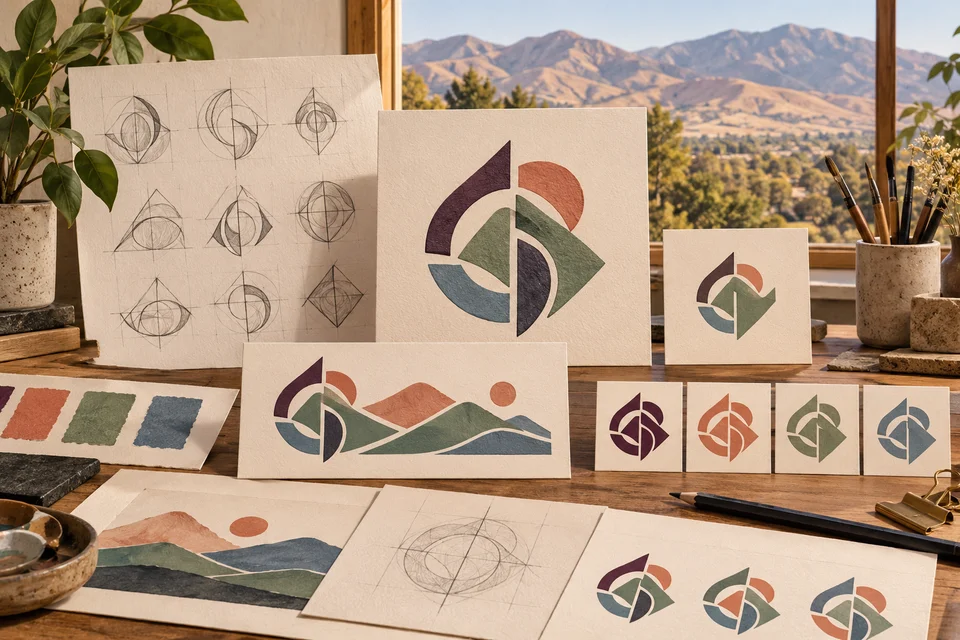
Your identity should travel with the business
A West Jordan business can be encountered in many settings: a referral, a digital search, a proposal, a storefront, or a service vehicle. A logo helps connect those encounters to the same name. Galactic Digital Studios approaches logo design as a practical identity decision, considering the audience and the uses the mark must survive rather than judging it only as an isolated picture.
West Jordan’s business community spans small home-based operations and international companies. Your identity needs to fit your position within that range. A company speaking mainly to household customers may want a different tone from a specialist selling to organizations. Neither requires imitating the scale or visual style of a larger neighbor to appear credible.
Local references are optional. A Salt Lake Valley landscape cue can be meaningful when it relates to the business story, but it can also produce a mark that resembles many others. Begin with what customers should remember about your company. Do not borrow West Jordan’s civic identity or imply an affiliation with a public institution, retail center, or employer simply to signal a local connection.
Consider how customers distinguish your West Jordan business from similarly named companies and from services based in other valley communities. The business name should remain readable without relying on a landscape symbol or a city label to explain it. Location can sit in supporting content, leaving the identity flexible if your legitimate service area later expands.

Separate the name decision from the drawing decision
Before developing a visual direction, establish which business name and wording the identity needs to carry. A long descriptive name, short trading name, and initials create different design opportunities. If a tagline is important, decide whether it must appear with the logo in every use or can be supporting copy. Small applications may not have room to reproduce the entire message clearly.
If the company already has recognition, identify what creates it. Customers may remember the word shape, a symbol, a color relationship, or a familiar vehicle presentation. A refinement can preserve useful elements while addressing poor spacing, inconsistent versions, or weak legibility. A complete change may be appropriate when the business has changed substantially, but it should be a considered decision with a rollout plan.
Map the cost of applying that decision. A new logo can affect signage, clothing, proposal templates, packaging, profile images, and the website. Some items can change immediately; others may be replaced as stock is used. Knowing the sequence helps avoid an extended period when customers encounter several unrelated identities. The design project and the cost of replacing physical materials should be planned separately.

Test the idea where recognition has to happen
Evaluate concepts using a small set of criteria tied to the brief. Is the business name easy to read? Does the visual tone fit the offer? Is the mark distinguishable when viewed quickly? Does it remain coherent without color? A concept that satisfies those requirements may be more useful than an elaborate symbol that needs a lengthy explanation before anyone understands it.
Application tests should reflect the first real uses. A horizontal website header has different proportions from a square profile image. A proposal cover may allow fine detail that a garment vendor cannot reproduce. Consider a primary arrangement and any justified alternatives, rather than forcing every application to use the exact same composition. Variants should remain recognizably part of one system.
Single-color and reversed versions reveal important limitations. Very thin lines may disappear, small gaps may close, and weak contrast may make a name unreadable. Production vendors can provide requirements for embroidery, vinyl, or other methods. Discuss those requirements before approval when they are central to the project. A realistic mockup helps visualize a use, but it does not prove the artwork is ready for every production process.

Make feedback specific enough to improve the direction
Discovery establishes the name, audience, business character, current identity, and required applications. Visual references help when you can explain what you respond to: clarity, warmth, precision, restraint, or another relevant quality. A collection of unrelated favorite logos is less useful than a clear account of how you want customers to perceive the company and why that perception fits the offer.
Concept development explores suitable directions, and review evaluates them against the agreed criteria. Choose a direction before refining every detail. Combining unrelated pieces from several concepts can weaken the underlying idea. When something does not work, explain the problem: the name feels secondary, the symbol suggests another industry, or the forms are too intricate for the main application. That gives refinement a concrete target.
Refinement adjusts proportion, spacing, letter relationships, and consistency between versions. Review both close-up artwork and small practical examples. Assign one person to gather stakeholder feedback and authorize decisions. This helps keep the project focused when staff have different preferences. The number of directions, review stages, and final applications should be described in the proposal instead of assumed to be unlimited.
Deliver an identity people can use consistently
A useful handoff explains which files to use and when. Scalable artwork supports many vendor needs, while digital exports serve websites, documents, and profiles. Ask for the formats and arrangements your team actually needs, including appropriate color and background variants. Confirm whether editable source files and any supporting identity guidelines are included. A folder full of unexplained filenames can undermine otherwise thoughtful work.
Usage guidance can address clear space, practical minimum sizes, approved colors, background choices, and alterations to avoid. If several employees or outside vendors use the identity, designate a source for the current files. That reduces the chance that someone stretches the artwork or rebuilds it from a screenshot. Discuss font and other third-party licenses so your team understands any continuing requirements.
Creative research is different from formal trademark clearance. Discuss potential confusion and distinctive visual direction during design, while obtaining qualified advice for registration or legal clearance when needed. Do not assume a logo proposal includes those services. Likewise, broader naming work, packaging, signage production, and a complete brand manual require their own scope if they are part of your plan.
Budget and timing depend on exploration, refinement, stakeholder approvals, variants, and application needs. Galactic’s existing identity portfolio provides concrete work to assess for composition and usability; the examples here are not represented as West Jordan client commissions. A recognizable mark supports a consistent presentation, while reputation also depends on customer experience, service quality, and the way the identity is used over time.

Questions about logo design in West Jordan
Should we put West Jordan in the business name or logo?
Only if it is part of the business strategy and approved name. Consider whether it helps customers understand the company and whether it remains appropriate for the area you actually serve.
Can a familiar logo be improved without a complete rebrand?
Yes, a refinement can address legibility, proportions, or inconsistent files while preserving recognizable elements. Start by identifying what customers remember and which practical problems need to be solved.
How many versions do we need?
The answer depends on the applications. A primary arrangement, compact option, and suitable color variations may cover different needs. Agree on the required set after reviewing where the logo will be used.
Does a new logo include new signs and clothing?
Artwork preparation and physical production are different scopes. Identify the intended vendors and uses early, then confirm who handles ordering, proofs, installation, and any production-specific adjustments.
What should we prepare before starting?
Bring the approved name, existing files, audience description, important competitors or points of confusion, and a prioritized list of applications. Establish who will consolidate feedback and make the final decision.
Connect the work across your business
West Jordan web and design services · West Jordan web development · West Jordan graphic design
Compare relevant service-area information for South Jordan and Taylorsville, or explore Galactic’s portfolio before discussing your scope.
Your next step
Make the next customer decision easier.
Tell us what customers already recognize and where your identity needs to work next. We can discuss a logo direction and practical handoff for your West Jordan business.
Discuss your West Jordan project