

A recognizable business deserves its own identity
Galactic Digital Studios offers logo design for businesses serving Breckenridge, Colorado. A logo gives people a consistent identifier across a website, proposal, card, or other business material. Its job is to help them recognize who is speaking. It does not need to illustrate every service or carry the entire story of the town to be useful.
Breckenridge’s historic Main Street and alpine setting offer familiar visual references. The Arts District adds another dimension to that context through creative spaces in adapted historic structures. Those influences can inform a conversation about character, but they should not determine the mark before the business itself has been understood. Your audience, name, and positioning are more useful starting points than a default mountain silhouette.
A year-round service business may want an identity that feels established and dependable. A visitor-facing shop may want a more expressive tone. These are possible directions, not fixed rules for those categories. The brief should explain the impression you want to create and the reasons it fits the actual customer experience.
Decide whether the problem is the mark or its use
Before commissioning a replacement, look at what is failing. A familiar logo may simply be available only as a small image, or staff may be using inconsistent versions. A full redesign may not be necessary to address those problems. On the other hand, a changed name, a substantially different offer, or a mark that no longer fits the business can justify a broader identity conversation.
Collect the current files and show where the logo appears. Note the applications that are difficult: a website header, a social profile, a narrow printed space, or a single-color reproduction. This turns a general dislike into a concrete brief. It also helps distinguish a logo project from a wider need for typography, color guidance, and coordinated materials.
If the business is new, settle the working name and essential positioning before asking a mark to solve them. Naming, trademark clearance, and design are different tasks. Identify any unresolved naming decisions early so the creative scope and schedule reflect them. Do not assume a visually original concept establishes legal availability or exclusive rights.

Explore an idea that can survive different applications
Galactic’s strategic approach begins with the business: what it does, whom it serves, and what makes its offer understandable. From there, visual directions can explore type, shape, proportion, and color. A useful concept has a clear rationale that relates to the brief. It should remain explainable without a long story that customers will never encounter.
For Breckenridge, local relevance might come through a restrained material palette, a sense of craft, or a tone suited to the business. Literal geography is optional. A hypothetical maintenance company and a hypothetical specialty shop could share a town while requiring entirely different identities. These examples are not local client claims; they demonstrate why category and audience matter.
Review the mark in simple conditions before relying on presentation effects. Does the business name remain readable at a small size? Can the shape work in one color? Does the composition need a horizontal and a compact version? These practical questions help distinguish a usable identity from an appealing image that depends on a large mockup.
Keep recognition steady while messages change
A logo is most useful when it can stay consistent across different campaigns. If your business changes featured services with the season, those messages can live in photography, headlines, and supporting graphics. The core identifier should not need reinvention every time you promote a new offer. That continuity gives returning customers something familiar to recognize.
List the important applications before finalizing the direction. A small website header and a large printed piece impose different demands. If a physical application such as embroidery or signage is planned, discuss the supplier’s constraints during development. A screen preview alone does not establish that every production method will reproduce fine details as intended.
Color and typography guidance can help the broader presentation remain coherent, but a logo package is not automatically a complete brand system. Define the deliverables explicitly. If the team needs templates, a website refresh, or a suite of printed pieces, identify that work as part of the scope or a planned follow-up rather than assuming it comes with the mark.

Make feedback about fit, clarity, and use
Discovery can gather the business story, current assets, audience priorities, and examples that help explain the intended tone. References are useful for discussing qualities, not for copying another company’s identity. Agree on what the project needs to deliver and who has authority to approve a direction before creative work moves into refinement.
When reviewing concepts, compare them against the brief. Explain whether a direction misrepresents the service, feels unsuitable for the audience, or becomes hard to read in an important application. Consolidated feedback gives the revision a clear purpose. A poll of unrelated personal preferences can obscure the actual decision the business needs to make.
At delivery, confirm the agreed file formats, color versions, spacing guidance, and practical usage instructions. Clarify ownership, source-file delivery, font licensing, and any third-party elements in writing. Schedule and cost depend on the breadth of exploration, revision needs, and applications included. A defined handoff helps the team use the identity consistently after the design phase is complete.

Judge the identity without the presentation effects
The Galactic portfolio offers visual work to discuss in terms of balance, readability, and consistency. When reviewing identity examples, imagine the mark without dramatic lighting, textured paper, or a large mockup. Ask what remains distinctive and whether the design can do its job in an ordinary business document or small digital space.
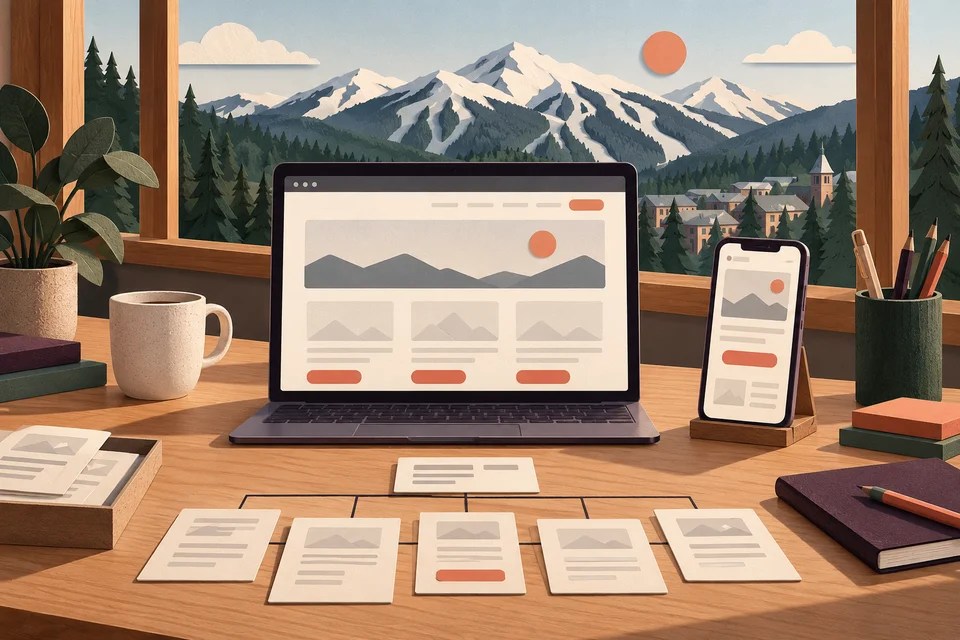
The illustrations here show conceptual design thinking, and existing portfolio examples are labeled separately. They are not evidence of Breckenridge clients or a local studio. A strong logo can support credibility and recognition, but reputation grows through repeated experience with the business. No mark can guarantee sales, search visibility, or a customer’s trust on its own.

Questions about logo design in Breckenridge
Does a Breckenridge logo need mountains or ski imagery?
No. Local references are optional and should serve the business’s identity. A distinctive wordmark or abstract symbol may be more appropriate. Evaluate whether a geographic motif clarifies who you are or simply resembles other businesses in a mountain setting.
Can we refresh an existing logo without losing recognition?
That may be possible. Identify the elements customers already recognize and the specific limitations you need to fix. Refinement can focus on readability or usability, while a major positioning change may call for a broader redesign. Review the existing assets first.
What logo files should the project include?
Discuss scalable artwork, suitable digital exports, color variations, and any compact or horizontal versions your applications require. The exact package should be stated in the proposal. File delivery and ownership terms should be clear before you approve the scope.
Is trademark clearance part of logo design?
Do not assume it is included. Creative review and legal clearance serve different purposes. If trademark questions affect the name or mark, arrange the appropriate separate review and account for it before committing to a broad rollout of finished materials.
How should we introduce a replacement logo?
Inventory the places the old identity appears, choose the priority updates, and prepare approved files for the people making changes. Coordinate the website and frequently used materials where practical. A clear transition plan helps reduce accidental use of outdated versions.
Explore related work for your business
Breckenridge web and design services · Breckenridge web development · Breckenridge graphic design · Explore the Galactic portfolio · Browse all service areas
Plan your next step
Give your business a mark that works beyond the mockup
Share your business name, the impression you want to create, and the places your identity needs to work. We can plan a Breckenridge logo project with a clear direction and practical deliverables.
Discuss your Breckenridge project