
Make the business recognizable beyond one setting
Logo design for a Santa Barbara business should begin with what the business needs people to recognize. Galactic Digital Studios develops visual identity directions around the name, audience, positioning, and places the mark will appear. A successful direction needs to communicate appropriately and survive ordinary use, from a website header to a small printed card.
Santa Barbara’s waterfront and downtown are useful local context, but they do not prescribe a logo. The city describes the waterfront as a place for both recreation and commercial activity. A business connected to that setting might consider a coastal reference; an unrelated professional service may be better represented by a different idea entirely.
The question is whether a visual choice tells people something relevant about your business. A familiar regional motif can create atmosphere, but it can also make unrelated companies look alike. We explore how much local character helps recognition and where a more individual direction would better serve the name.
Decide whether to refine or replace the existing mark
A new logo is not always the right starting point. Review what customers already recognize and what currently fails. The mark may be hard to read at small sizes, lack usable files, or feel inconsistent across materials. Those issues can suggest refinement rather than a complete break with an established identity.
A more substantial redesign may make sense when the business has changed its name, audience, or positioning. In that case, define what should carry forward and what should change. The brief should explain the business reason for the work rather than simply requesting something more contemporary.
For a Santa Barbara business with both recurring local customers and occasional new visitors, continuity can matter. Consider how existing materials will be updated and whether people will still recognize the business during the transition. The design decision and the rollout decision belong in the same conversation.

Treat the logo as a small working system
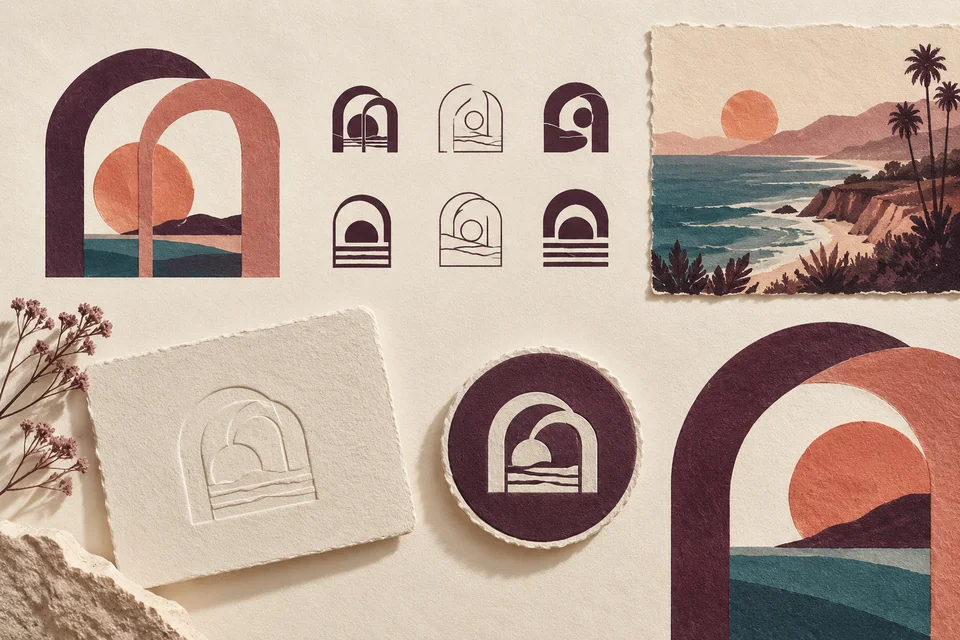
A useful identity may need more than one arrangement. A horizontal version can suit a website header, while a compact version may work better in a profile image. A monochrome option helps where color reproduction is limited. The exact set should follow actual applications rather than an arbitrary package of files.
Test the name at realistic sizes. Fine details, thin strokes, and long descriptors can disappear when the mark is reduced. If the business name is lengthy, explore how typography and spacing can preserve readability without forcing every application to use a tiny version of the full composition.
Color should support the identity without carrying its entire meaning. Review the mark on light and dark backgrounds and in a single color. A direction that remains recognizable across these conditions gives the business more practical flexibility when it moves between digital screens, printed materials, and other agreed uses.
Use a clear brief to evaluate creative directions
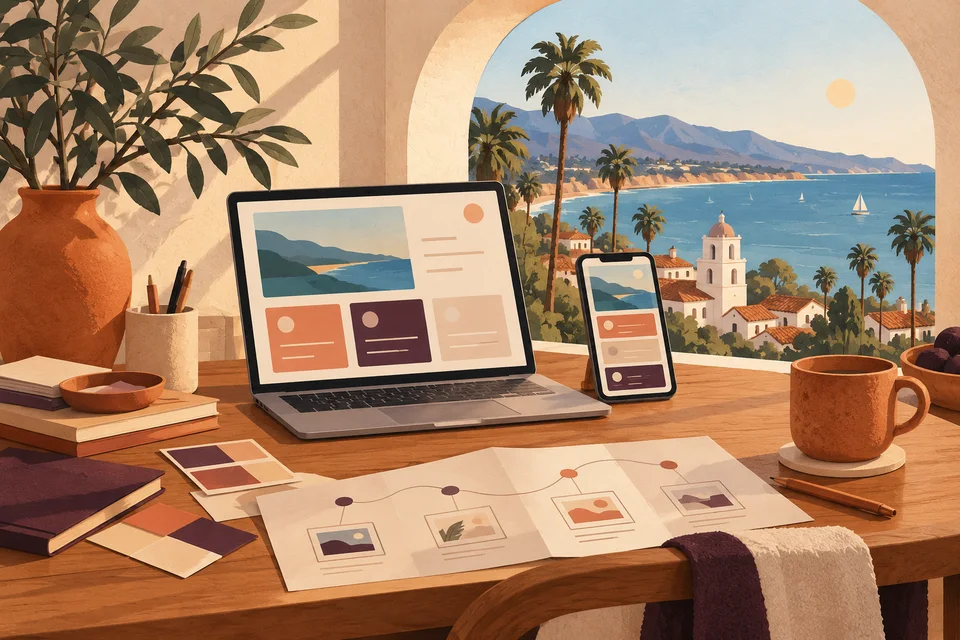
The brief connects business goals to design choices. It can describe the desired impression, audience expectations, competitive context, and essential applications. References are useful for discussing qualities such as warmth, precision, or simplicity, but they should not become instructions to imitate another company’s identity.
We can explain how a proposed direction addresses the brief and show it in relevant applications. Reviewers should ask whether the name reads clearly, whether the impression fits the offer, and whether the mark remains identifiable without decorative surroundings. These questions make feedback more useful than voting on favorite colors alone.
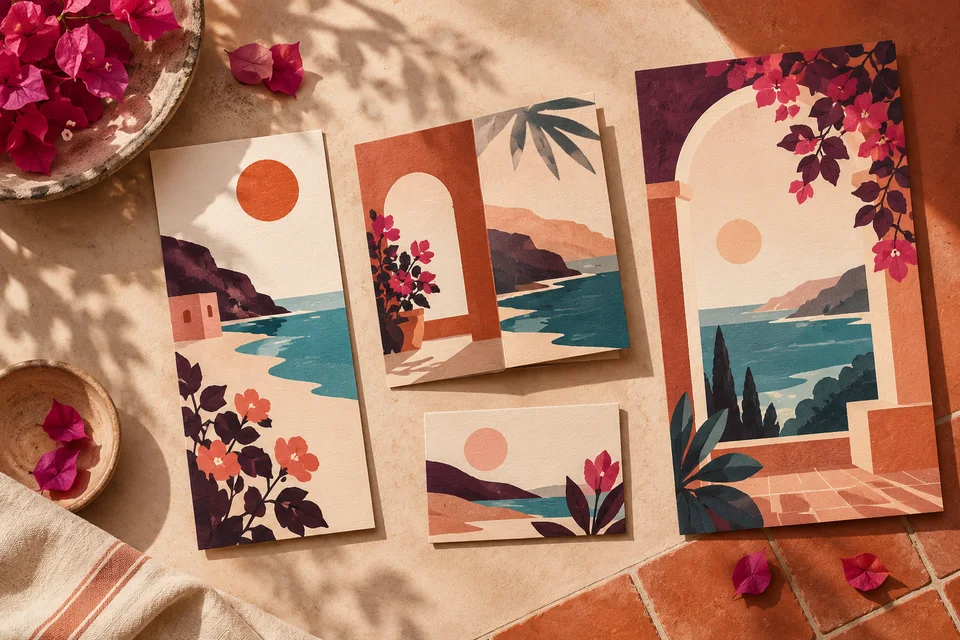
Local character can enter through proportion, rhythm, or a restrained palette instead of a literal landmark. Concept illustrations on this page explore that possibility without representing a real Santa Barbara business. The final identity should emerge from your own brief and should not imply a civic, waterfront, or other institutional affiliation.
Let’s plan logo design around your Santa Barbara customers’ next decision.
Refine the chosen direction through realistic tests
A logo project can move from discovery to initial directions, focused feedback, refinement, and a final delivery set. Agree on decision-makers and review expectations early. A consolidated response helps distinguish an essential business concern from a collection of unrelated personal preferences.
Once a direction is selected, refine spacing, proportions, and relationships between the name and symbol. Compare versions at realistic sizes rather than reviewing only a large presentation. A small website header or modest printed card often reveals practical issues that a dramatic mockup conceals.
Before delivery, confirm the approved spelling, arrangements, colors, and background treatments. Discuss usage guidance and the files needed by the people who will apply the identity. A supplier should not have to reconstruct a logo from a screenshot because the usable version was never included in the handoff.

Plan the files, rights, and rollout together
Scope depends on the depth of exploration, complexity of the identity, number of applications, and whether supporting brand guidance is included. A focused logo project differs from a full identity rollout across documents, packaging, signage, and a website. List the immediate uses and identify later extensions before comparing proposals.
Ask which vector and raster formats are included, whether editable source files are part of delivery, and what usage terms apply. Fonts and other licensed elements may have separate requirements. Establish these details in the agreement so the business understands how it can use and maintain the finished assets.
Creative review is separate from legal clearance of a business name or trademark. Discuss any unresolved naming questions before investing in final artwork, and seek appropriate professional review when needed. Timing should allow for approvals and rollout dependencies; a finished logo file does not automatically update every existing customer touchpoint.

Look past the presentation mockup
Galactic’s portfolio provides existing work for a discussion about identity craft and application. Ask what makes a mark recognizable, how it handles small sizes, and how consistently it appears across materials. The portfolio examples on this page are not presented as Santa Barbara client work.
For your own direction, evaluate both the polished presentation and the plain artwork. A logo should work without dramatic lighting, textured paper, or an attractive scene around it. Better recognition can support credibility over time, but trust also depends on the business’s service, communication, and consistent use of the identity.
Questions about logo design in Santa Barbara
Does our logo need a coastal symbol?
No. A coastal reference is useful only when it supports the business and audience. Typography or an abstract idea may provide stronger differentiation. Local relevance should inform the brief without forcing the mark to resemble a destination logo.
Can we keep part of our current identity?
Yes, refinement can preserve recognizable elements while improving usability. Start by identifying what customers know and what fails in practice. The scope should distinguish a focused update from a broader repositioning or complete redesign.
Which files should we request?
Discuss scalable vector files, suitable screen images, color variations, and the arrangements needed for your applications. Confirm source-file delivery and usage terms in the agreement. File names and simple guidance help staff choose the correct version later.
How should our team give feedback?
Use the agreed brief and realistic applications as the reference. Explain the concern rather than prescribing an isolated visual change. One consolidated response helps resolve competing views and keeps refinement connected to the business purpose.
Will logo design include all our marketing materials?
Only if those applications are included in the scope. A logo system can provide a foundation for future graphics and web work, but each additional format requires its own content, layout, and production decisions. Plan the rollout priorities explicitly.
Connect the next part of your project
Santa Barbara web & design services · Santa Barbara web development · Santa Barbara graphic design · Explore the Galactic portfolio · Browse all service areas
Plan your next step
Give your business a useful next step
Bring your business name, current identity, and the places the logo needs to work. We can define a Santa Barbara logo project around recognition, practical use, and a manageable rollout.
Discuss your Santa Barbara project