
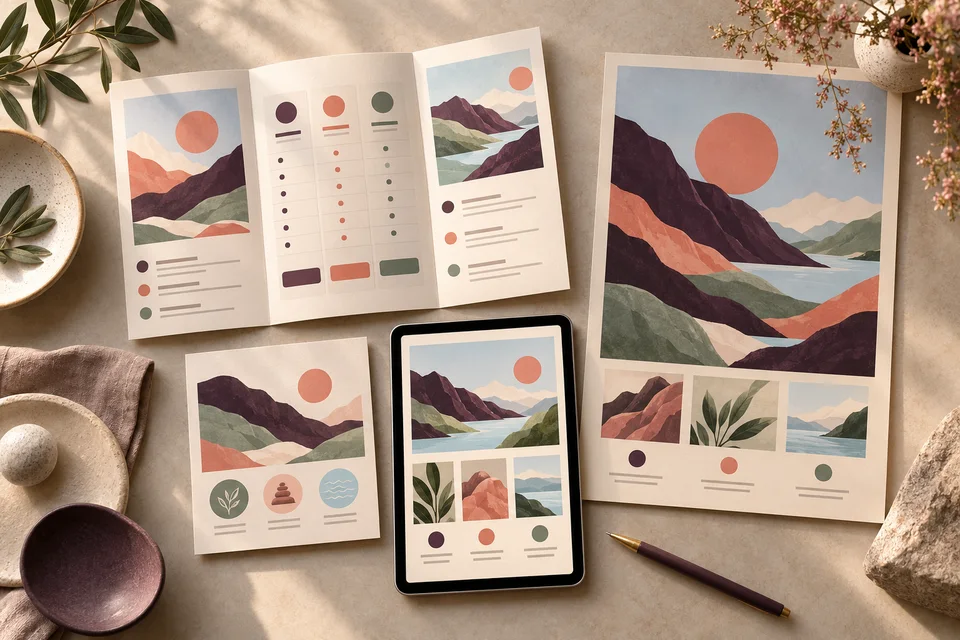
Give every business material a useful job
Galactic Digital Studios provides graphic design for American Fork, Utah businesses that need clearer print and digital communication. A brochure, service sheet, or presentation should help someone understand an offer or make a decision. We shape the content and visual hierarchy around that purpose, so an attractive piece also earns its place in your customer experience.
American Fork has a documented historic downtown, with the city’s walking tour connecting buildings around Main Street and nearby streets. That gives local businesses a setting with an established identity, but your materials still need to communicate your own role. A familiar place name or local image cannot substitute for a clear explanation of what you sell and why the reader should keep going.
Choose the format after choosing the reader’s task
Begin with the situation in which the material will be used. A customer studying two service options needs an easy comparison. Someone preparing for a visit needs a short sequence and the information to have ready. A person sharing your offer with a colleague needs a self-contained explanation that does not depend on having heard your sales conversation.
For a hypothetical American Fork business, a compact preparation card could be more useful than a large general brochure. For another, a proposal template with consistent headings might make every follow-up clearer. These are possible applications, not descriptions of local client work.
Decide how the reader receives the piece and what action follows. That helps determine length, format, and the prominence of the call to action. A document made for careful review can carry more detail than a sign meant to communicate one idea at a glance.

Make comparisons fair and qualifications visible
When a business offers several options, design should make the differences easy to inspect. Use consistent categories across the choices so readers can compare like with like. Separate included services from optional additions, and place meaningful qualifications where they will be noticed rather than hiding them in an isolated block of small text.
The same principle applies to promotions. Give the central message a clear hierarchy, then make dates, eligibility, and next steps readable at the intended size. If the terms change frequently, consider whether a durable printed piece should direct readers to current information on your website.
A shared document must also carry enough context to make sense on its own. Use a descriptive title, the relevant service name, and a visible way to continue. Do not depend entirely on color to communicate categories, because the piece may be printed in grayscale or viewed on a small screen.

Build consistency into the working files
Our approach begins with the message and the existing identity. We review logos, colors, images, and approved wording, then establish a layout that gives each kind of information a predictable place. Consistency helps readers recognize the business while making the materials easier for your team to update.
We work with realistic content during design. Long service names, variable descriptions, and actual images reveal constraints that a neat placeholder layout can conceal. If a template is part of the scope, test it with both a short and a detailed example before treating it as ready for repeated use.
Typography, spacing, and image choices should support the intended reading conditions. A slide presented in a room, a PDF read on a phone, and a printed leave-behind need different judgments about density and scale. Coordinated design does not mean exporting one layout unchanged into every format.

Let’s plan American Fork business materials that make your offer easier to compare.
Plan production and future edits before approval
List the required outputs: print dimensions, digital sizes, page counts, and any editable templates. Ask the printer or production provider for specifications before final artwork is prepared. Bleed, safe areas, color handling, and finishing can affect the design; a beautiful preview is not a substitute for the vendor’s requirements.
Clarify who supplies copy, photography, and approved brand assets. Confirm how any stock images or fonts may be used, and what licenses or source files are part of the handoff. If another team member will edit the material later, identify the software they actually have and the level of flexibility they need.
Budget and timing depend on original content, the number of formats, illustration or image work, and the review process. Distinguish design delivery from printing or installation. Production services and coordination should be discussed in the scope rather than assumed to accompany every graphic design project.
Review the piece in the conditions it will face
Discovery establishes the audience, message, format, and distribution method. A short content outline can expose missing details before design begins. Identify the person responsible for approving the offer and any conditions so the finished piece does not carry conflicting instructions.
The first visual direction shows how the hierarchy and identity work together. Evaluate whether the most important idea is obvious, whether supporting details follow in a sensible order, and whether the reader knows what to do. Feedback about those questions is more actionable than a collection of unrelated style preferences.
Refinement should include checking real output sizes. Print a proof where useful, inspect the digital version on a phone, and check that a QR code or link goes to the intended destination. Before handoff, proofread approved details and organize the final versions so obsolete artwork is less likely to be reused.

Keep the design connected to the rest of the business
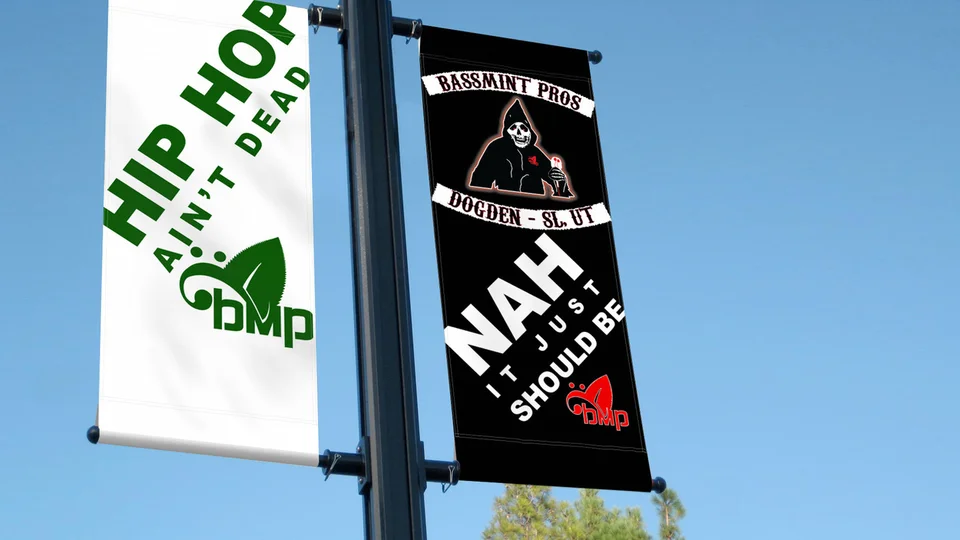
Review our graphic design portfolio for hierarchy, consistency, and practical applications. Portfolio images shown here are selected studio examples, not American Fork commissions. Mockups illustrate how artwork might appear on an object; they do not establish that a sign was installed or that a campaign produced a measured result.
Materials work better when the destination matches their message. Coordinate printed explanations with your American Fork website, and resolve missing identity variations through logo design when needed. The local service overview can help you decide which part of that system deserves attention first.
After delivery, maintain one approved place for current files and assign an owner for changes. Good design supports clearer communication over time when the underlying offer, qualifications, and linked information remain accurate.
American Fork graphic design questions
Can you design a single service sheet?
A focused piece can be a useful starting project. Define the reader, the service, and the action it should support, then agree on the content and output formats. You do not need to commission a complete set of materials.
Should the PDF match the printed brochure exactly?
The identity can stay consistent while the layout adapts to the medium. A brochure with folds may be awkward to read on a phone. Discuss a separate digital layout when it materially improves the reading experience.
Are printing and installation included?
Treat production as a separate scope discussion. Confirm who orders, approves proofs, manages vendor specifications, and handles delivery or installation. The agreed design deliverables should clearly identify which production responsibilities are included.
Can our team update the materials?
If ongoing editing matters, include templates and suitable file formats in the brief. The right handoff depends on your software and skills. Some elements may remain fixed to preserve the layout while routine content becomes editable.
What should we check before approving artwork?
Check names, service details, dates, qualifications, links, and reading size. Review the actual final version, not an earlier draft. For printed work, follow the production provider’s proofing process before authorizing a run.
A practical next step
Give your American Fork customers business materials that make the next decision clearer.
Bring your current materials, the questions you want to resolve, and the priorities for your next project. We can use that context to define a focused scope and a sensible sequence for the work.
Discuss your American Fork project