

Make useful information easier to keep
A customer may understand your service during a conversation and still need something clear to refer to afterward. A preparation sheet, proposal, or welcome document can preserve the important details without asking them to remember everything. Galactic designs these materials around the action they support, from comparing options to preparing for an appointment or sharing a recommendation with someone else.
Canterwood is listed by Pierce County as an unincorporated community near the Gig Harbor area. For businesses working across nearby communities, a document may need to explain coverage without making the location the entire message. We keep the business name, service, and next step prominent, with geographic wording that reflects actual operations. A residential setting is useful context, but it does not establish an audience's budget, tastes, or relationship with your company.
Begin with the document people actually need
List the materials your team sends most often and the questions that follow them. If people repeatedly ask what is included, the scope information may need a clearer hierarchy. If they miss preparation instructions, the document may be mixing essential actions with background detail. If staff keep recreating the same attachment, a reusable layout can reduce inconsistency while preserving room for project-specific information.
The first deliverable might be a two-page service guide rather than a large brochure. A digital handout might be more useful than a printed piece if your customers receive it by email. Choosing the format after defining the audience and purpose helps avoid paying to produce something that looks polished but does not fit the way your business communicates.

Give each piece a clear reading order
A useful document makes its purpose visible before asking the reader to study details. We organize headings, short summaries, supporting explanations, and contact information so someone can scan first and read more closely when needed. Important distinctions belong in the main layout: what the service includes, what the customer supplies, and what requires a separate conversation.
A preparation guide, for example, can group actions by when they happen. A proposal can separate the recommended scope from optional additions. These are illustrative structures rather than claims about previous Canterwood projects. The copy must still be approved by your business, especially where a document describes schedules, prices, guarantees, credentials, or any other promise that customers may rely on.
Build a small visual system around your content
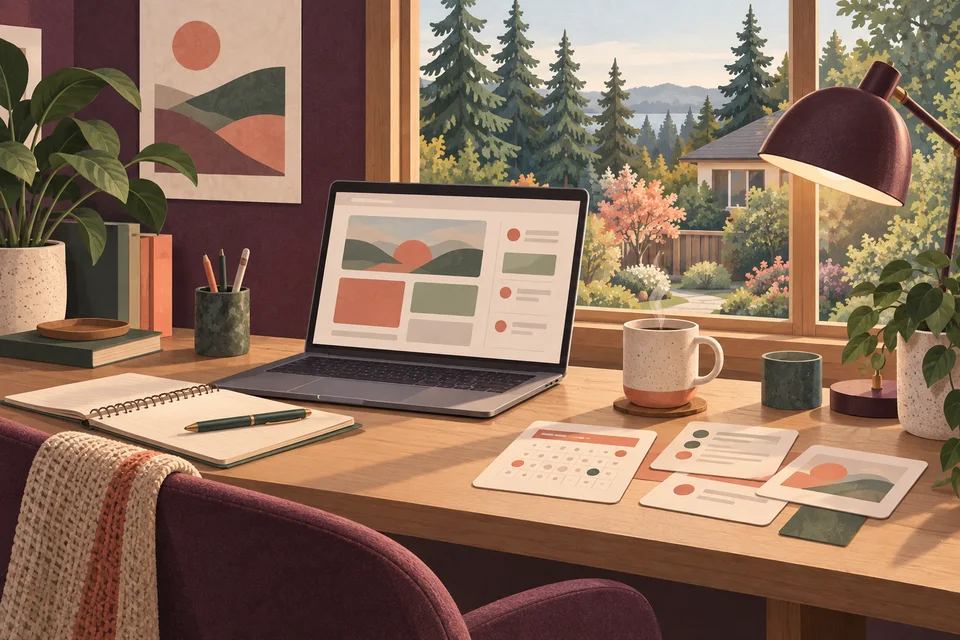
We review existing brand assets and select a practical combination of type, color, spacing, and image treatment. The aim is a recognizable family of materials, with enough flexibility for different lengths and purposes. A one-page reminder and a longer proposal should feel related without forcing every item into the same arrangement.
An initial layout uses realistic content so we can examine what happens when a service title is long or a paragraph needs another line. That is especially important for templates your team will edit later. We can identify which elements should stay consistent and which should be flexible before producing the rest of the set.
Feedback is most useful when it describes a reading problem or a factual correction. Once the direction is approved, we apply it to the agreed formats and review the final content in context, including contact details and the intended next action.

Plan formats, revisions, and production together
Cost depends on the number of original layouts, amount of content, image preparation, revision needs, and output formats. Five versions of a card are different from five unrelated brochures. Tell us about expected variants at the start so the project can account for changing staff names, service categories, or distribution channels without surprising your team later.
Print production adds its own requirements. Finished size, folding, paper choice, bleed, and supplier specifications affect the files. Printer coordination and physical proof review should be included when needed. For digital materials, we consider file size, readable text, and the way recipients will open or share the document. Editable source files, licensed fonts, and future updates also need clear treatment in the agreement.
Check the material where it will be used
A document that looks comfortable on a large monitor may be difficult to read as an email attachment on a phone. A printed card can expose tiny type or weak contrast that was less obvious on screen. Review at the intended size and in the intended channel. A quick reading test can reveal whether the key instruction or service distinction is visible without explanation.
Before delivery, verify names, dates, phone numbers, web addresses, and any scannable codes. Check that links lead to the correct page and that the destination remains useful after a campaign ends. For reusable templates, try a realistic edit and export. This tests whether the person maintaining the material can produce a good result without having to reconstruct the design.

Use consistency to support the conversation
The portfolio can help you assess how Galactic handles hierarchy, imagery, and the relationship between content and space. It provides visible examples of design choices, not evidence of affiliation with a Canterwood association or a promise that a particular brochure will produce sales. A useful review connects what you see to the communication problem your own material needs to solve.
Canterwood web development can provide an online destination for a printed piece, and Canterwood logo design can establish missing identity rules before a larger document family is produced. If your existing brand already works, we can build on it. The important question is whether customers and staff can recognize the business and understand the information consistently across the materials they encounter.
Questions about graphic design in Canterwood
Can you design a welcome or preparation packet?
Yes. Start with the information a customer needs after making contact. We can organize it into a suitable format and identify which details belong in a reusable document versus a personalized message from your team.
Can our staff edit the finished materials?
That can be included when the project is scoped. Tell us which software staff use and what they need to change. Editable templates require deliberate setup, appropriate licenses, and a realistic review of how they will be maintained.
Is printing included?
Printing and design are separate items unless the agreement says otherwise. We can discuss production specifications and coordination, but quantities, supplier costs, proof approval, and delivery dates need to be confirmed for the actual print job.
Can one design work for print and email?
Often the same visual direction can support both, but the output files may differ. Print requires production settings, while an emailed version needs suitable size and usable links. We plan the required formats before final production.
Do we need new photography?
Not always. Existing images may be suitable if their resolution, relevance, and usage rights are clear. We can identify gaps and discuss options. Illustrations and conceptual images should be presented honestly rather than treated as photographs of completed customer work.
Related services and nearby areas
Canterwood web & design services · Canterwood web development · Canterwood logo design · Artondale services · Gig Harbor services · Galactic portfolio
Plan your next step
Put clearer communication to work.
Tell us which materials customers receive today, who updates them, and what those materials need to explain. We can shape a Canterwood graphic design project around the documents your business will actually use.
Discuss your Canterwood project